
Newton's Laws of Motion Explained - IGCSE / O-Level Physics (Forces, F=ma & Motion)
Forces and motion is one of the highest-scoring topics in IGCSE Physics — and it all rests on three short rules written by Isaac Newton. Master them and you can explain almost any motion question in your exam.
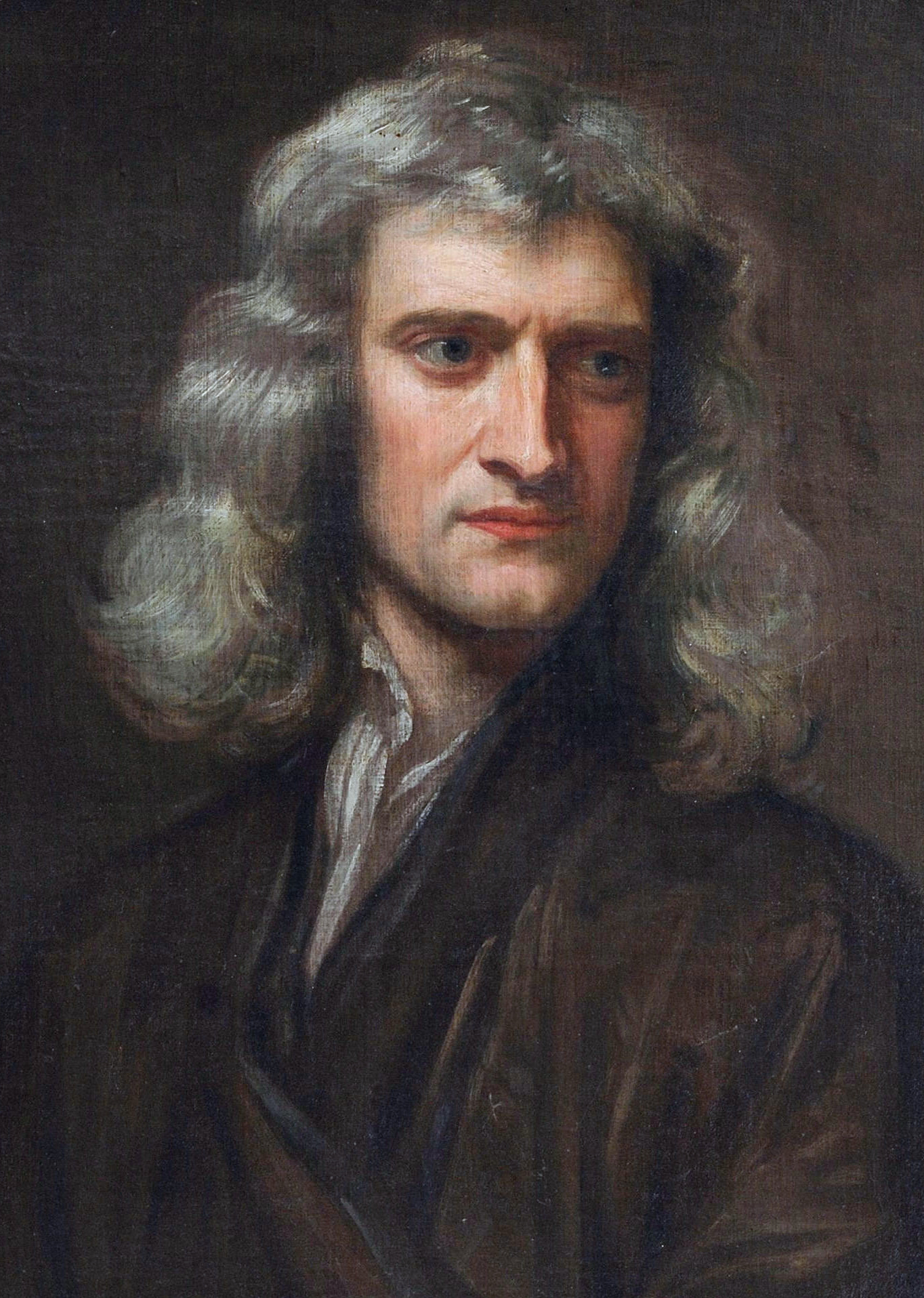
Sir Isaac Newton (portrait by Godfrey Kneller, 1689 — public domain, Wikimedia Commons)
What is a force?
A force is a push or a pull, measured in newtons (N). Force is a vector — it has size and direction — so we draw forces as arrows. Always start with a free-body diagram: the object as a box with every force shown as a labelled arrow.
Balanced vs unbalanced forces
When forces are balanced, the resultant force is zero. When they are unbalanced, a resultant force remains. Add forces in the same direction and subtract those in opposite directions to find it.
Newton's First Law (Inertia)
An object stays at rest, or keeps moving at constant velocity in a straight line, unless a resultant force acts on it.
Balanced forces mean the motion never changes — this is inertia. Example: a passenger lurches forward when a car brakes, which is why we wear seatbelts.
Newton's Second Law (F = ma)
F = m × a
- F = resultant force (N)
- m = mass (kg)
- a = acceleration (m/s²)
Worked example: A 1000 kg car experiences a resultant force of 2000 N.
a = F ÷ m = 2000 ÷ 1000 = 2 m/s²
Newton's Third Law (Action–Reaction)
For every action there is an equal and opposite reaction.
If A pushes B, then B pushes A equally in the opposite direction — and crucially these forces act on different objects. A rocket pushes gas down; the gas pushes the rocket up. Exam trap: a book's weight and the table's push are equal and opposite but act on the same object, so they are not a third-law pair.
Mass vs Weight
| Mass | Weight | |
|---|---|---|
| What it is | Amount of matter | Force of gravity |
| Unit | kilograms (kg) | newtons (N) |
| Changes? | Same everywhere | Depends on gravity |
Weight = mass × g, where g ≈ 9.8 N/kg on Earth.
Exam tips
- Always draw a labelled free-body diagram.
- Find the resultant force before using F = ma.
- Rearrange carefully and show your working.
- Always include units.
▶ Watch the full lesson on YouTube | 👍 Follow ISLAC on Facebook
Subscribe to ISLAC for daily IGCSE / O-Level exam prep.


Comments
Post a Comment